
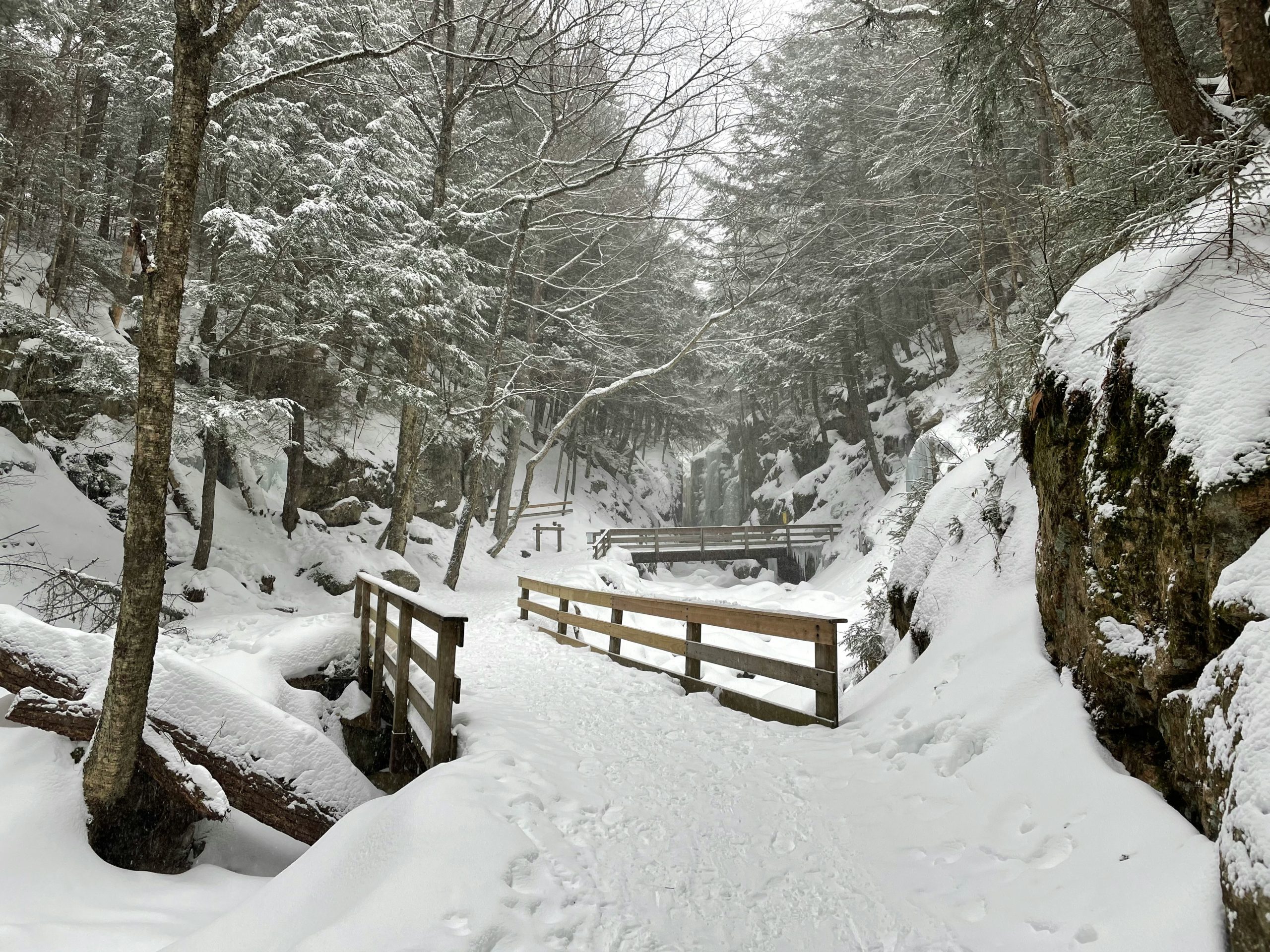
There is a particular deception that occurs at the trailhead of Mount Lafayette in December, when the parking lot sits at the elevation of mere hills and the sky above the Franconia Range shows only innocent blue. The trail begins in forest so familiar it might be any woods in New England—snow-dusted spruce, the occasional chickadee, the reassuring crunch of microspikes on packed powder. Hikers have been lulled here before, interpreting the civilized beginning as a promise of what awaits above.
Shane Squires and Robert Conlon began their hike on a Friday afternoon in mid-December, two men from Massachusetts who had likely seen photographs of the Franconia Ridge—those iconic shots of hikers traversing an exposed knife-edge with winter white stretching to every horizon. They started at one o’clock, which in summer would provide ample time for a nine-mile loop, but in December gives you barely four hours of daylight before the sun drops behind the western ranges and the temperature begins its rapid descent toward single digits. By the time they reached the summit of Mount Lafayette, elevation 5,249 feet, the light was already leaving, and the mountain had begun to reveal its other self.
Above the tree line in the White Mountains, winter is not merely a season but a set of physical conditions that do not negotiate. The wind finds its full voice, unchecked by forest, racing across the exposed granite with gusts that can knock a person off balance or steal the feeling from fingers in minutes. Temperatures drop ten to twenty degrees from the valley below. The trail, so obvious in summer, becomes a suggestion buried under drifting snow. Visibility can shrink from miles to yards in the time it takes to remove a glove and check a phone. The mountain does not care about your experience level, your gear, your intentions, or your family waiting at home. It simply is—indifferent, ancient, and capable of killing you without malice or intent.
Squires and Conlon reached the summit, which is an accomplishment under any conditions, but the Franconia Ridge loop requires you to earn your way down as well. Somewhere on the descent, above the protective canopy of the forest, they lost the trail. The details from the rescue report sketch a familiar story: waist-deep snow, winds they had not anticipated, temperatures around ten degrees. One of them fell, claimed an injury, could not continue. The other began showing signs of severe hypothermia— that dangerous phase when the body stops shivering and the mind drifts toward unconsciousness. They called for help at 9:45 p.m., eight hours after they had started, having discovered what generations of hikers have learned: that the mountain permits you to turn back at any point, but it does not permit you to ignore its conditions.
New Hampshire Fish and Game rescued them in the early morning hours, a team of conservation officers and volunteers who left their own warm beds to ascend a frozen peak in darkness. The rescue report noted that the hikers had “lost their composure and would not listen to any advice,” a detail that suggests panic had taken hold, that most dangerous of conditions above the tree line. Panic makes you sweat, which makes you wet, which makes you cold faster. Panic makes you move rashly, missing the trail markers, wasting energy, making decisions that seem logical to a hypothermic brain but are in fact shortening the time until your core temperature drops below the threshold of survival. The officers who rescued them said what officers always say in these situations: they were unprepared, lacking proper gear, lacking experience, lacking the humility that the mountain requires.
What separates the experienced winter hiker from the novice is not primarily equipment, though that matters. It is the imagination—the ability to picture yourself at the summit in forty-mile-per-hour winds when you are still in the parking lot enjoying the shelter of your car. It is the willingness to turn around when the conditions exceed your preparation, to abandon the goal of the summit in favor of the goal of survival. The White Mountains have killed experienced climbers and spared novices who happened to have the luck or sense to retreat. But the mountain favors those who understand that the wilderness does not grade on effort or intention, only on preparation and judgment.
The culture of winter hiking in New Hampshire includes an ethic of self-reliance that borders on the austere. Experienced hikers carry what they need to survive a night on the mountain, because they understand that rescue might not arrive before hypothermia does. They check weather reports obsessively, not just for temperature but for wind speed and wind chill and the possibility of cloud cover that would obscure the cairns marking the trail. They know the names of the dead—those memorial plaques scattered on various peaks—better than they know the names of celebrities. They speak of the mountain in terms that acknowledge its power: “Lafayette was permitting it today,” or “the ridge was closed for business.” This is not anthropomorphism but accuracy. The mountain has conditions, and those conditions either allow your passage or they do not.
Squires and Conlon survived their night above the tree line, rescued by professionals who train for exactly these scenarios. They will likely return to Massachusetts with a story they will tell for years, a cautionary tale about underestimating the Whites in winter. But the mountain remains, indifferent to their lesson learned or not learned. It will be there tomorrow, and the day after, offering the same challenge to the next hiker who stands at the trailhead interpreting the blue sky as a promise rather than a condition subject to change. The Franconia Ridge will still stretch exposed above the trees, beautiful and deadly, requiring of everyone who attempts it the same thing it has always required: adequate preparation, sound judgment, and the humility to know when the mountain is not permitting your passage, regardless of how far you have already come.
Based on reporting from NHPR, Valley News, and New Hampshire Fish and Game rescue reports from December 2025.